

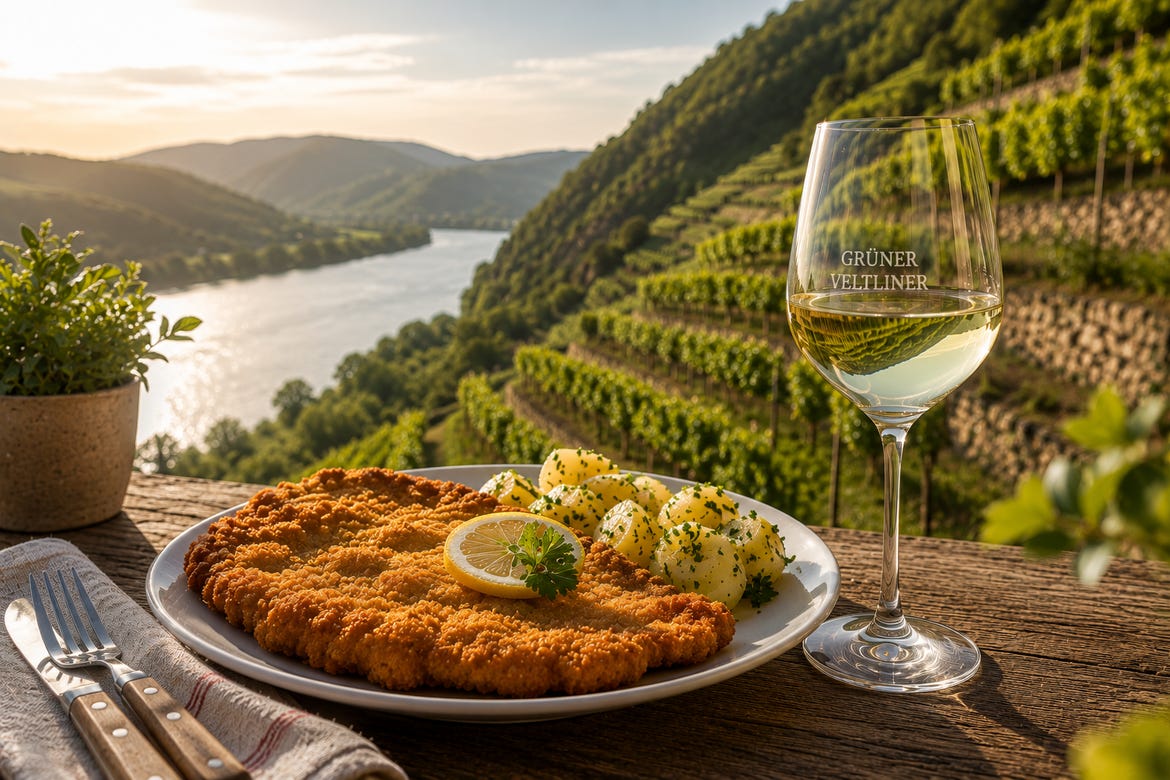
Grüner Veltliner: Austria’s Flagship Grape Variety Explained
If one had to choose a single wine to represent Austria in a glass, the decision would likely be straightforward. Grüner Veltliner is not only the country’s most important grape variety, but also one of the most exciting white wine varieties in Europe. Austria’s flagship grape variety is grown across more than 14,500 hectares and displays an impressive range of styles, from an easy-drinking everyday wine to top-quality wines capable of ageing for decades.
This versatility is precisely what makes Grüner Veltliner so distinctive. At times fresh and peppery, at others powerful and complex; sometimes an unpretentious accompaniment to a meal, at others a fine wine for special occasions. Few grape varieties manage this range so effortlessly.
But what defines this wine? Where does it come from? Why does it pair so well with Wiener Schnitzel? And which wineries should you know? These are the questions we will now explore in more detail.
What exactly is Grüner Veltliner?
Grüner Veltliner is Austria’s most important white wine grape variety and is widely regarded as the flagship of the country’s wine industry. No other grape is cultivated on a larger scale in Austria.
Although the name may sound Italian, the variety is closely associated with Austria. Nowhere else does it play such a central role. It shapes the country’s wine landscape like almost no other grape variety and is now featured on the wine lists of leading restaurants around the world.
Above all, it stands out for its versatility. From fresh summer wines and elegant food companions to great single-vineyard wines with decades of ageing potential, Grüner Veltliner offers remarkable breadth.
Grüner Veltliner in figures
The importance of this grape variety is reflected in the official figures:
| Key figure | Grüner Veltliner |
|---|---|
| Area under cultivation in Austria | 14,548 ha |
| Proportion of total vineyard area | 32.5% |
| Ranking among Austria’s grape varieties | 1st |
| Main growing regions | Weinviertel, Wachau, Kamptal, Kremstal, Wagram, Traisental |
| Highest concentration | Weinviertel |
| Significance | Austria’s most important grape variety |
This means that almost one in three vines in Austria is a Grüner Veltliner. Particularly notable is the Weinviertel, where around 6,800 hectares are planted with this variety. As a result, almost every second bottle of Grüner Veltliner originates from Austria’s largest wine-growing region.
The story of an Austrian success
Today, Grüner Veltliner is one of Europe’s best-known white wines, although this was not always the case.
For many years, the grape was mainly used to produce simple everyday wines. It was only in the 1980s and 1990s, when ambitious winemakers began to explore its full potential, that its reputation changed.
It soon became clear that Grüner Veltliner was capable of far more than fresh, easy-drinking wines. Outstanding examples from the Wachau, Kamptal, Kremstal and Traisental attracted international attention and appeared on the wine lists of leading restaurants worldwide.
Today, Grüner Veltliner is regarded as one of Europe’s most exciting white grape varieties and as the flagship of Austrian viticulture.
The St. Georgen vine – an almost lost heritage
For a long time, the origins of Grüner Veltliner remained unclear. It was only in 2000 that DNA analysis revealed part of its lineage.
The St. Georgen vine was identified as one of its parent varieties, an old Austrian grape that was thought to be virtually extinct. The discovery of a single surviving vine in St. Georgen in Burgenland was therefore all the more remarkable. This vine made it possible to preserve and propagate the variety once again.
This was a fortunate discovery, as without it an important part of Austria’s wine heritage might have been lost.
This is what Grüner Veltliner tastes like
Those who have never tasted this grape variety often ask what Grüner Veltliner tastes like. The answer depends on many factors.
This variability is one of the variety’s greatest strengths. Depending on origin, soil, climate and vinification, it can display a wide range of characteristics.
Typical aromas include:
- Green apple
- Pear
- Citrus fruits
- Herbs
- White pepper
- Stone fruit
- Occasional exotic fruit notes
Young, lighter wines are often fresh, crisp and lively, whilst more powerful single-vineyard wines tend to show greater depth, structure and complexity.
Why does Grüner Veltliner taste of pepper?
Few characteristics are as closely associated with Grüner Veltliner as the well-known ‘Pfefferl’.
This is not actual pepper, but a distinctive spicy aroma found in many wines made from this grape. It is particularly common in wines from the Weinviertel region.
Today, the ‘Pfefferl’ is one of the variety’s defining features and contributes greatly to its appeal.
The main growing regions for Grüner Veltliner
If you would like to explore the differences between the regions for yourself, you will find our selection of Grüner Veltliners from across Austria here.
Weinviertel
The Weinviertel is widely regarded as the home of Grüner Veltliner. The grape has shaped the region for generations and has its own designation of origin, the Weinviertel DAC.
The characteristic peppery note is especially pronounced here. The wines are typically fresh, fruity and offer excellent value.
Explore our wines from the Weinviertel
Wachau
The Wachau is one of Europe’s most renowned wine regions. Some of Austria’s most prestigious Grüner Veltliners are produced on the steep terraces along the Danube.
These wines often display power, depth and impressive ageing potential.
Discover the wines of the Wachau
Kamptal
The Kamptal combines elegance with expressiveness. Its Grüner Veltliners are often precise, delicately spicy and well balanced.
View our wines from the Kamptal
Kremstal
The Kremstal produces characterful wines with a harmonious balance of fruit, spice and freshness.
Discover wines from the Kremstal
Wagram
The loess soils of the Wagram often give the wines a distinctive richness and creamy texture.
Traisental
Although smaller, the Traisental has an excellent reputation. Its cool nights and limestone soils produce precise, elegant and mineral-driven wines.
Explore wines from the Traisental
Grüner Veltliner and food
Grüner Veltliner is one of the most versatile white wines when it comes to food pairing.
Its combination with Wiener Schnitzel is particularly well known. The wine’s fresh acidity cuts through the richness of the breadcrumb coating, whilst its spice complements the veal.
It also pairs well with:
- Fried chicken
- Asparagus
- Fish and seafood
- Poultry
- Asian dishes
- Vegetable dishes
Can Grüner Veltliner be aged?
Many people drink Grüner Veltliner young, which is perfectly appropriate for fresh styles. However, its ageing potential is often underestimated.
The finest wines from regions such as the Wachau and Kamptal can mature for many years, developing additional complexity, herbal notes and depth.
A Wachau speciality: Steinfeder, Federspiel and Smaragd
These terms refer to Wachau classifications that describe the style and maturity of the wines.
Steinfeder indicates light, fresh wines.
Federspiel refers to medium-bodied, elegant wines.
Smaragd describes the most powerful and age-worthy wines.
Selected wineries
Tegernseerhof
A leading Wachau estate known for precision and ageing potential.
Domäne Wachau
A benchmark producer demonstrating the full stylistic range of the region.
Schloss Gobelsburg
A historic Kamptal estate combining tradition with modern quality.
Markus Huber
A key figure in establishing the Traisental’s international reputation.
Leo Sommer
Produces expressive and approachable wines in Burgenland.
Conclusion
Grüner Veltliner is more than just a grape variety. It defines Austrian wine culture.
From simple everyday wines to complex, age-worthy examples, it offers a diversity that is rarely matched. Anyone wishing to understand Austrian wine should become familiar with Grüner Veltliner in its many forms.
Frequently asked questions
Is Grüner Veltliner always dry?
Most examples are dry, although some sweet styles exist.
Why does it taste of pepper?
The peppery note is a natural aromatic characteristic of the grape.
How long can it be kept?
Basic wines for a few years; top wines for ten to twenty years or more.
What is the ideal serving temperature?
Between 8 and 12 degrees Celsius, depending on the style.
What do Steinfeder, Federspiel and Smaragd mean?
These are quality classifications from the Wachau region for different wine styles.
Which wineries produce particularly good Grüner Veltliner?
Among the best known are Tegernseerhof, Domäne Wachau, Schloss Gobelsburg, Markus Huber and Leo Sommer.
Latest reviews
-
Torre Zambra Montepulciano d'Abruzzo D.O.C Valle Maris 2024 Bio, 0,75 l
- Organic Montepulciano with ageing in French oak
- Cherry, plum, raspberry, violet and liquorice
- Velvety, powerful, spicy and yet very harmonious
-
Dopff au Moulin Cremant d'Alsace Cuvée Julien Brut, 0,75 l
- Pinot Blanc and Auxerrois fermented using the traditional method
- From a top sparkling wine region
- Perfect as an aperitif or with food
-
-
Don Román Don Román Cava Brut, 0,75 l
- Made following the traditional method
- Fine cava for lovers of high-quality sparkling wine
- Great balance of acidity and sweetness
-
-
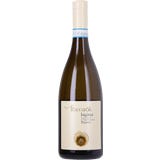
Fraccaroli Lugana DOC Pansere 2025, 0,75 l
- Top Lugana from Lake Garda
- Grape variety 100% Turbiana, the typical grape variety for Lugana
- The ideal summer wine, but with depth
-




Magazine Articles:
-
Austria: Free standard delivery from € 49,90
-
We operate in a
climate-conscious manner. -
Free
returns Secure payments
with SSL encryption technology